
Hurricane Supplication Day

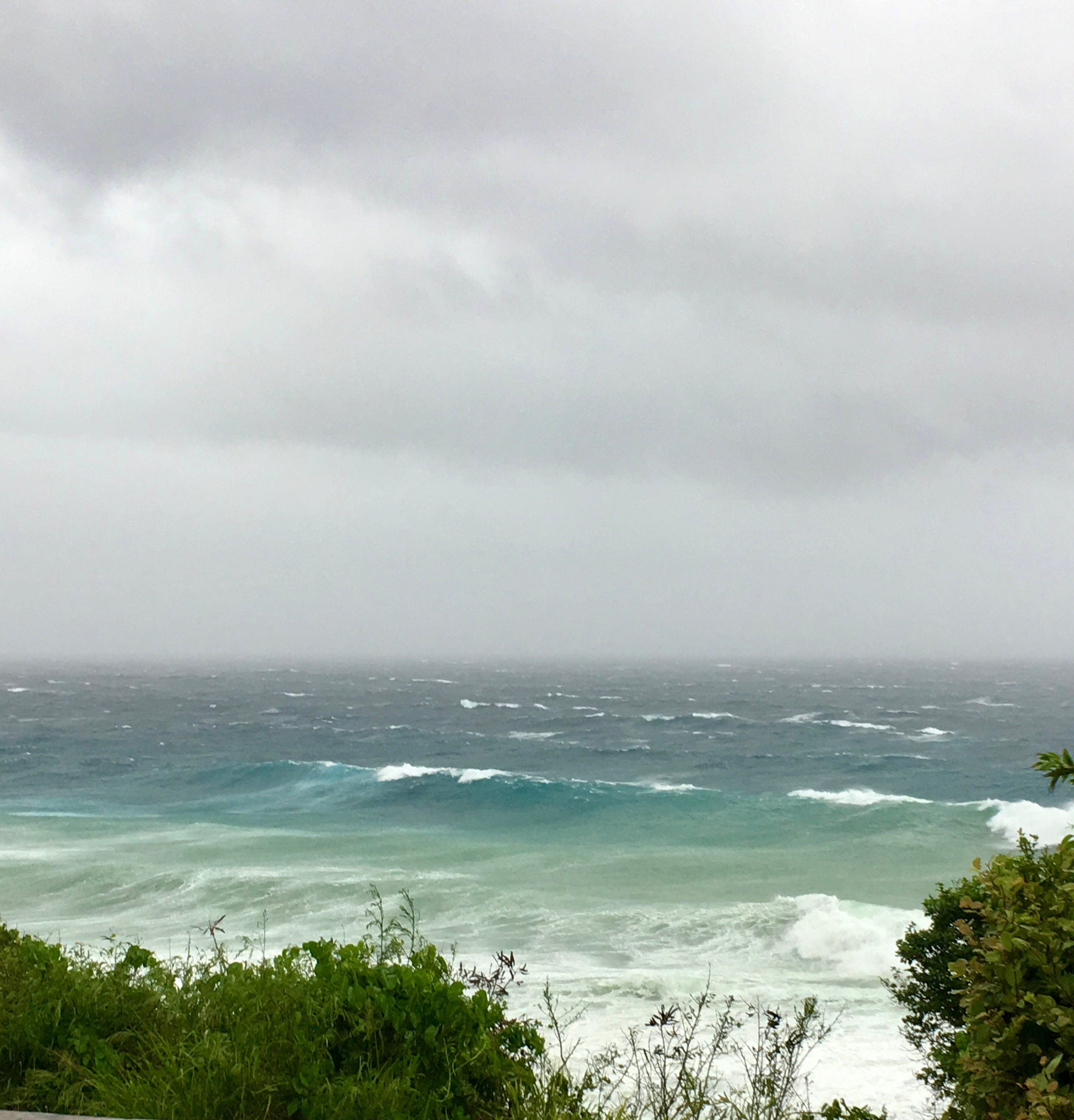
Sitting in the safe bubble of a writing retreat in the mountains of New Mexico, my hurricane tracker app whoohooohooed, because, for some perverse reason, it uses the unmistakable moan of hurricane winds to send notifications. I immediately broke into a cold sweat.
That’s my reaction every time I hear it, a legacy of the 2017 storms in the Virgin Islands that upended my life. (I wrote more about that here). This time, the notification was not a storm alert but a seasonal hurricane prediction, estimating the number of named storms likely to occur in the Atlantic Basin this year.
Seasonal predictions, issued months before the first tropical low-pressure system forms off west Africa, have an oracle-like quality. With or without magic, the forecast is powerful enough to stress me out: the higher the estimate, the more intense my worry.
Hurricanes are a reality of living in the Virgin Islands. So much so that on the 4th Monday of July we celebrate Hurricane Supplication Day, and on the 4th Monday of October, Hurricane Thanksgiving Day.
In July 1726, on the island of St. John in the then Danish West Indies, Lutheran pastor Philip Adams Dietrich performed the first Hurricane Intercessory Service and then the first Hurricane Thanksgiving Service in late fall.
Possibly the services were inspired by older European rogation days – religious ceremonies asking divine protection from storms, famine or disasters. Whatever the origin, for 300 years both days have appeared on the calendar, bracketing the months when most hurricanes hit the islands.
Hurricane Supplication Day is a uniquely Virgin Islands approach to acknowledging our collective anxiety about the risk hurricanes pose. Until very recently we did not have the technology to predict hurricanes. Imagine watching growing clouds on the horizon. Every dark sky from mid-summer to fall could be a portent of death. Hurricane Supplication Day created a space in time to acknowledge that shared anxiety and cope with uncertainty.
Home is not only geography. Belonging somewhere involves feeling like you are part of the social fabric of a place. When the bonds among community members are strong, communities recover faster from storms.1 For generations, these holidays have given shape to a reality every Virgin Islander recognizes: the long months of watching the sky and waiting. Wondering. Worrying. Acknowledging that reality is one way to connect the people who share it, and to lessen the stress.
A ritualized community day like Hurricane Supplication Day helps people process fear together before disaster and highlights the shared nature of the risk. In the same way, Hurricane Thanksgiving Day gives the community a time and place to express relief, collectively. We are still here.
As science advances and provides more information about hurricane season, we are forgetting to care for our emotional selves. Having predictive models only goes so far. Forecasts warn us, but they do not help us navigate the dread that comes with waiting for the winds to arrive. Waiting to know how bad the damage will be.
Data points are not designed to address or acknowledge anxiety. That’s why in the mainland U.S. people joke about hoping the Weather Channel’s Jim Cantore isn’t coming to town and use the Waffle House scale to determine the likely severity of a storm (It takes a lot to close a Waffle House). It’s worry disguised by humor, a way to respond to the vulnerability hurricane season brings.
But this is not just a hurricane problem.
More people are finding themselves living with the same cycle of anticipation, loss, and recovery that has long defined hurricane season. Wildfire, floods, tornadoes, deadly heat waves: as storms and other perils increase in frequency and severity, people need a container to hold their feelings that goes beyond handing out MREs and water bottles to survivors.
We need to acknowledge our collective anxiety about changes that are happening, and about our uncertain climate future. We need both pathways to connect people and reminders that we can rely on our community to respond when disaster strikes. Facing our fears together will make us better able to cope if disaster happens.
There’s room in our culture for science and ritual as we’re trying to adapt to climate change. Ritual does not necessarily involve religion. Annual festivals, moments of silence, public art installations, parades - it does not matter what form it takes. We need events like Hurricane Supplication Day to remind us that we are not navigating a changing climate alone. Shared rituals strengthen the ties between neighbors, reminding people that home is something built together. Working to build those connections now is one action we can take to respond to the unknow
What do you wish existed in your community? What festival, art installation, parade or other gathering would be the best way to bring people together to acknowledge their fear around the biggest threats to your community?
See Daniel P. Aldrich, Building Resilience: Social Capital in Post-Disaster Recovery (University of Chicago Press, 2012).
That and other hurricane apps I have went off at roughly the same time, and so began a change in conversations in the Virgin Islands, "Do you think it will really be that bad?", "I think the Sahara Dust is going to help.", "Do you think we'll get lucky again this year?", "We haven't finished rebuilding, we can go through another one yet!". A simple App notice kicking off a change in conversation. And as climate change affects our life's, I have heard comments direct towards the rituals which are as significant as many other holidays to those of us call the Caribbean home - "Do we need to bring Hurricane Supplication Day forward? "Do we need to push Hurricane Thanksgivings Day later?" Even as I site here writing this, I send a silent prayer... Please protect us through another year. This is part of this place.